Prawdziwe nagrania po angielsku
Trzy autentyczne materiały o wojsku i bezpieczeństwie międzynarodowym — z transkrypcją, pytaniami i słownictwem po polsku. Wszystkie w domenie publicznej, wszystkie z naszego serwera.
To nie są nagrania egzaminacyjne
I dobrze, żebyś o tym wiedział, zanim zaczniesz porównywać. Ta strona ma dwa różne tory ćwiczeń i mylenie ich robi więcej szkody niż pożytku.
Zadania egzaminacyjne
Znajdziesz je w Zadaniach. Dialogi pisane pod konkretny poziom: kontrolowane tempo, dobrane słownictwo, czysty dźwięk studyjny, przewidywalna struktura. Tak wygląda materiał na egzaminie.
Prawdziwe nagrania — ta strona
Materiał dziennikarski, nagrany dla ludzi uczących się angielskiego. Wolniejszy niż zwykłe radio, ale szybszy i gęstszy niż egzamin. Nikt go nie kalibrował pod poziom 2 czy 3, bo nie po to powstał.
Służy do rozrobienia ucha: oswojenia z naturalnym tempem, akcentem i słownictwem, którego w ćwiczeniach nie ma. Nie służy do oceniania własnego poziomu. Jeśli zrozumiesz połowę, to nie znaczy, że nie zdasz — znaczy tylko, że to trudniejszy materiał niż egzaminacyjny. Prawdziwy próg i prawdziwy format opisuje strona Przebieg egzaminu.
Jak z tego korzystać
- Raz bez niczego. Napisy wyłączone, tempo 1×. Nie zatrzymuj, nie cofaj. Na egzaminie też nie będziesz mógł.
- Odpowiedz na pytania. Od razu, na tym, co zapamiętałeś. Nie zaglądaj do transkrypcji — to jedyny moment, w którym dowiesz się czegoś prawdziwego o swoim słuchaniu.
- Sprawdź wyjaśnienia. Przy każdym pytaniu jest napisane, dlaczego pozostałe odpowiedzi są złe. To jest ważniejsze niż sam wynik — dystraktory na egzaminie budowane są dokładnie tak samo.
- Dopiero teraz napisy i tempo 0,75×. Posłuchaj drugi raz z transkrypcją i zobacz, co dokładnie umknęło: całe zdanie czy jedno słowo, które zmieniało sens.
Czy operacje pokojowe ONZ tracą na znaczeniu?
Kanada miała w latach 90. ponad trzy tysiące żołnierzy w operacjach pokojowych ONZ. Dziś ma kilkudziesięciu. Materiał tłumaczy, dlaczego Zachód wycofał się z tej formuły i co zajęło jej miejsce.
Wypowiedzi trzech ekspertów, argumentacja przyczynowo-skutkowa i słownictwo polityczno-wojskowe. Trzeba rozdzielić fakt od opinii i zapamiętać, kto co powiedział — dokładnie to sprawdza poziom 3.
Czego słuchać
- Kto mówi. Padają trzy nazwiska i trzy różne opinie — na egzaminie pytanie brzmi zwykle according to X, a nie what is true.
- Słowa osłabiające: in part, largely, it remains to be seen. Zdanie z takim zwrotem prawie nigdy nie potwierdza odpowiedzi kategorycznej.
- Liczby z kierunkiem: over 3,000 → a few dozen. Sama liczba nie wystarczy, trzeba wiedzieć, czy rośnie, czy spada.
Is UN Peacekeeping Losing Its Appeal?
0 / 5In the early 1990s, Canada had over 3,000 troops deployed in peacekeeping missions around the world. Today, it has only a few dozen.
Canada is not the only Western country to have greatly reduced such missions. The drop in numbers, military experts say, demonstrates the changing nature of conflict in a post-Cold War world.
Major Tim Dunne is a retired officer in the Canadian Armed Forces. He was deployed in several peacekeeping operations. Now, he is a researcher for the Canadian Global Affairs Institute. He said United Nations peacekeeping is „falling out of fashion.” In other words, it is becoming less common and popular.
Dunne told VOA that before the collapse of the Soviet Union in 1991, most international conflicts were driven by competition between the United States and the Soviet Union. He said this created the need for a neutral army to stand between them.
Dunne said that most modern conflicts, like in Syria and Iraq, are too complex for peacekeeping to work.
„The factors that allow for effective peacekeeping aren’t there anymore,” Dunne said.
It is not only Canada that is rethinking the value of United Nations’ peacekeeping.
Emily Estelle works for the Washington-based American Enterprise Institute. Estelle points to the lack of public support in Western nations for the costly and sometimes dangerous missions.
She used the Sahel, an area in Africa, to explain the change in operations.
She said France leads the counterterrorism operation in Mali but is working to end its involvement and the operation. She said it is in part because of pressure within France and an upcoming election.
She also said Mali and Somalia, which is facing a similar situation, would not be able to replace the influence peacekeepers have, „if and when they withdraw.”
In Canada’s case, the country’s long-standing history to U.N. peacekeeping operations has largely been replaced by involvement in NATO (North Atlantic Treaty Organization) operations. These include involvement in the operation that defeated the Islamic State extremist group in Iraq and Syria and the NATO operation, now ending, in Afghanistan.
Canadian Prime Minister Justin Trudeau’s administration has promised to deploy more troops and police to international peacekeeping. But the proposed numbers remain only in the hundreds.
Charlie Herbert is a former top-level NATO advisor to the Afghan Ministry of the Interior and a former director at the Defense Academy of the United Kingdom.
Herbert said Britain is showing some interest in bringing new life to U.N. peacekeeping. He sees this as a reaction to the decision to pull NATO forces out of Afghanistan.
He told VOA, „The withdrawal from Afghanistan marks the end of an era.”
He also said the withdrawal provides the chance for „…all Western nations to reconsider the use of their military as an instrument of their foreign policy.”
He said Britain is using this as a chance to reinvest in high-end peacekeeping operations. It remains to be seen if other Western countries will follow Britain’s lead.
Nagrania nie udało się wczytać. Poniżej masz pełną transkrypcję — przeczytaj ją raz, w normalnym tempie, i dopiero potem odpowiadaj.
Nagranie i transkrypcja: VOA Learning English — Jay Heisler (VOA), opracowanie Gregory Stachel, redakcja Ashley Thompson, 2021. Domena publiczna, plik bez zmian w treści.
What has happened to Canada’s peacekeeping contribution since the early 1990s?
- It has grown from a few dozen to over 3,000
- It has fallen from over 3,000 to only a few dozen
- It has stayed at roughly the same level
- It was stopped completely in 1991
According to Major Dunne, why did peacekeeping work better before 1991?
- The United Nations had more money for missions
- Conflicts were driven by US–Soviet rivalry, so a neutral force had a role
- Soldiers were better trained for peacekeeping duties
- There were far fewer conflicts in the world
What has largely replaced UN peacekeeping in Canada’s case?
- Duties inside Canada’s own borders
- Training missions run by the United Nations
- Taking part in NATO operations
- Nothing — Canada left all international missions
Why, according to Emily Estelle, is France ending its operation in Mali?
- Because the operation has achieved its goals
- Partly because of pressure at home and an approaching election
- Because Mali asked French forces to leave
- Because the United Nations took the operation over
What does Charlie Herbert think the withdrawal from Afghanistan means?
- The end of all Western military involvement abroad
- That NATO should be dissolved
- A chance for Western states to rethink the military as a tool of foreign policy
- Proof that peacekeeping has finally failed
Słownictwo z tego nagrania
Amerykańska agentka: Virginia Hall
Historia jednej z najskuteczniejszych agentek aliantów II wojny światowej. Zaczyna się w Warszawie — w 1931 roku Hall pracowała w ambasadzie amerykańskiej w Polsce.
Opowieść prowadzona chronologicznie, konkretne wydarzenia, proste zdania. Trudność polega na utrzymaniu kolejności zdarzeń, bo bohaterka zmienia kraj co kilka zdań.
Czego słuchać
- Kolejność. Warszawa, Estonia, Austria, Turcja, Paryż, Londyn, Lyon, Pireneje, Hiszpania, znowu Francja — wszystkie te miejsca padają, ale pytanie dotyczy zwykle jednego konkretnego momentu.
- Zwrot But. W tym nagraniu zapowiada informację punktowaną: But her injury did not stop her…
- Warunki złożone: the only female civilian. Dwa warunki naraz — pominięcie jednego daje złą odpowiedź.
American Spy: Virginia Hall
0 / 5Thousands of women have served as intelligence agents for the United States and its allies since the nation began.
Virginia Hall was one of the bravest and most successful spies for the Allies during World War II.
Hall was born in 1906 to a rich family in Baltimore, Maryland. She studied foreign languages in college.
In 1931, Virginia Hall took a job at the American Embassy in Warsaw, Poland. Then she served in embassies in Estonia, Austria and Turkey.
While in Turkey, Virginia Hall suffered a tragic accident. Her gun accidentally fired while she was hunting. The bullet severely wounded her leg. Doctors removed it to save her life. After that, she wore a wooden leg to walk. She resigned from the State Department as a result. But her injury did not stop her from serving the Allies.
Virginia Hall was in Paris, France when World War II began. She joined the French Army and drove a medical vehicle. Before long, however, she had to leave to escape the invading German soldiers. Later, in England, she was invited to join a secret British organization created to organize resistance. It helped form military teams in German-occupied areas of Europe.
Hall learned weaponry, communications and security. Then she was sent to occupied France. She established communications with the French Resistance movement in Lyon. She successfully plotted the escape of many allied airplane crews and prisoners of the Germans. She saved many lives.
Later she escaped from France over the Pyrenees Mountains in the southern part of the country during the winter. After a time in Spain, however, Hall again spied in France. This time she was working for the United States Office of Strategic Services.
Hall dressed as a farm worker to hide her identity. She reported German troop movements and organized Resistance groups. By now, the Germans knew who she was. Some called her the most dangerous enemy agent in occupied Europe.
The Resistance fighters she organized gained great success. As the Germans withdrew from France, the fighters killed many enemy soldiers. They took hundreds of prisoners. They exploded four bridges. They destroyed communication lines.
The United States honored Virginia Hall with a Distinguished Service Cross medal when the war ended. She was the only female civilian in the war to receive this medal.
Nagrania nie udało się wczytać. Poniżej masz pełną transkrypcję — przeczytaj ją raz, w normalnym tempie, i dopiero potem odpowiadaj.
Nagranie i transkrypcja: VOA Learning English — Jerilyn Watson (VOA Learning English), 2025. Domena publiczna, plik bez zmian w treści.
Where did Virginia Hall work in 1931?
- At the American Embassy in Warsaw
- In the French Army in Paris
- At an embassy in Turkey
- In England, for a secret British organisation
What caused Virginia Hall’s injury?
- An enemy attack during the invasion of France
- Her own gun going off while she was hunting
- A fall while crossing the Pyrenees in winter
- An explosion at the embassy in Turkey
What did Hall do after the accident?
- She stopped working for the government for good
- She left the State Department but went on serving the Allies
- She returned to Baltimore and stayed there
- She was given a desk job at the embassy
How did Hall hide her identity in occupied France?
- She wore a French army uniform
- She used a false embassy passport
- She dressed as a farm worker
- She never left the house during the day
Why was her Distinguished Service Cross unusual?
- She received it twice, in 1944 and 1945
- She was the only female civilian in the war to be given it
- It was awarded to her before the war ended
- It was awarded to her by the British government
Słownictwo z tego nagrania
Gettysburg — pole bitwy i muzeum
Największa bitwa wojny secesyjnej i miejsce, w którym Lincoln wygłosił dwuminutowe przemówienie znane dziś każdemu Amerykaninowi. Materiał powstał we współpracy z amerykańską służbą parków narodowych.
Narracja opisowa z dużą liczbą dat i liczb. Sprawdza to, co na egzaminie najbardziej boli: cztery różne liczby w jednym nagraniu, każda przypisana do czegoś innego.
Czego słuchać
- Cztery liczby: 170,000, 50,000, 1 million, two minutes. Każda dotyczy czegoś innego. Notuj nie samą liczbę, tylko parę liczba + do czego.
- Definicje w przelocie: cyclorama — this kind of artwork completely surrounds the people looking at it. Nagranie samo tłumaczy trudne słowo — nie trzeba go znać wcześniej.
- Nazwy własne: Meade, Lee, Pickett, Lincoln. Nie musisz ich zapisywać poprawnie, musisz wiedzieć, po której stronie stoi każdy.
American Places — Gettysburg, Pennsylvania
0 / 5The Gettysburg National Military Park is in the small town of Gettysburg in the eastern state of Pennsylvania.
Much of the area around Gettysburg still looks like it did in the 1860s, during the American Civil War. The town is in the middle of good farmland. Roads pass through Gettysburg that lead to Baltimore, Washington, D.C., and other eastern cities. It is hard to believe that two huge armies fought there.
One fighting force was the United States Army of the Potomac, commanded by General George Meade. The other was the Confederate Army of Northern Virginia led by General Robert E. Lee. Lee’s troops had moved north into Pennsylvania from Virginia.
Lee believed that a Southern win of a battle on Northern land would force a negotiated settlement of the Civil War and mean independence for the Confederate States.
The battle of Gettysburg began on July 1, 1863. About 170,000 soldiers fought for three days. When it ended on July 3, more than 50,000 soldiers were dead, wounded or missing.
Lee’s army lost the battle.
Many visitors start their visit to Gettysburg at the Gettysburg Museum of the Civil War. The museum has a large collection of Civil War objects. The museum has more than 1 million artifacts, from soldiers’ private notebooks and clothing to maps of the battlefield.
The museum also houses the Gettysburg cyclorama painting. This kind of artwork completely surrounds the people looking at it.
The painting shows the artist’s vision of the final major attack of the battle on July 3, 1863. Over time, it has come to be called Pickett’s Charge. George Pickett was one of several Confederate commanders ordered to make the charge.
The Confederate soldiers reached a point close to the northern lines and headquarters. Today, the point is called the „High Water Mark.” Northern forces then turned the Confederates back.
The charge failed. Southern forces would never again reach so far north. Soon after the battle, people began to visit Gettysburg to try to understand what happened there. One of those visitors, on November 19, 1863, was President Abraham Lincoln. He was invited to help dedicate a burial ground for Union soldiers killed in the battle.
Lincoln spoke for just two minutes. But his speech, known as „The Gettysburg Address,” is one of the most famous pieces of American oratory.
Nagrania nie udało się wczytać. Poniżej masz pełną transkrypcję — przeczytaj ją raz, w normalnym tempie, i dopiero potem odpowiadaj.
Nagranie i transkrypcja: VOA Learning English — Nancy Steinbach i Ashley Thompson, z materiałami National Park Service, czyta Mario Ritter Jr., 2025. Domena publiczna, plik bez zmian w treści.
How long did the battle of Gettysburg last?
- One day
- Three days
- A week
- Two minutes
About how many soldiers were dead, wounded or missing?
- About 170,000
- More than 1 million
- More than 50,000
- About 3,000
Why did General Lee move his army north into Pennsylvania?
- To capture Washington, D.C.
- He hoped a win on Northern land would force a negotiated settlement
- To defend Virginia against an attack
- To join up with the Army of the Potomac
What is a cyclorama?
- A detailed map of the battlefield
- A monument standing on the battlefield
- A painting that completely surrounds the viewer
- A collection of soldiers’ notebooks
How long did Lincoln speak at Gettysburg?
- Two minutes
- Three days
- Two hours
- The recording does not say
Słownictwo z tego nagrania
Skąd te nagrania i dlaczego wolno je tu trzymać
Wszystkie trzy pochodzą z VOA Learning English — serwisu Głosu Ameryki dla osób uczących się angielskiego. Redakcja pisze na swojej stronie wprost:
„Learning English texts, MP3s, photos and videos are in the public domain. You are allowed to reprint them for educational and commercial purposes, with credit to learningenglish.voanews.com.”
VOA Learning English — Request Our Content
Dlatego pliki leżą na naszym serwerze, a nie są wczytywane z zewnątrz. To nie jest drobiazg: gdyby odtwarzacz sięgał po plik do VOA, Twój adres IP trafiałby do amerykańskiego nadawcy przy każdym odtworzeniu. Serwis nie zbiera żadnych danych i nie zamierza robić wyjątku dla dźwięku.
VOA wyłącza z domeny publicznej materiały agencyjne: „stories, photos and video images from news agencies such as AP, Reuters and AFP are copyrighted, so you are not allowed to republish them”. Sprawdzamy to przy każdym pliku po podpisie autora. Z tego powodu odrzuciliśmy gotowy materiał o szczycie NATO, choć tematycznie pasował najlepiej ze wszystkich znalezionych — napisała go agencja AP.
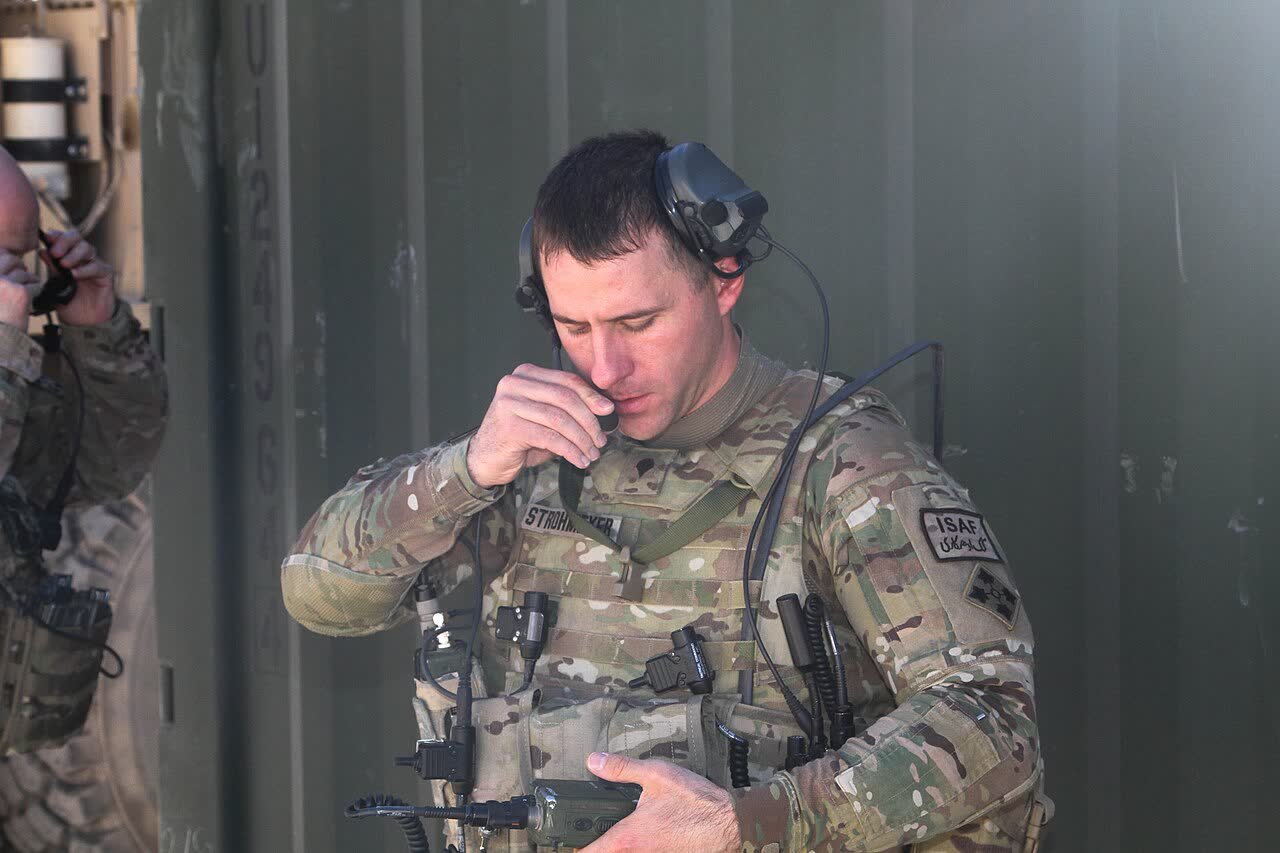
Ta sama zasada obowiązuje w całym serwisie: struktura egzaminu to fakt i wolno ją opisać, ale zadania piszemy od zera, bo oficjalne modele egzaminacyjne są chronione prawem autorskim. Zdjęcia pochodzą z zasobów Departamentu Obrony USA, też w domenie publicznej.
Będzie więcej
Zestaw rośnie razem z resztą serwisu — nowe zadania i nagrania pojawiają się co kilka dni. W planie jest osobny blok łączności radiowej, gdzie przełącznik szumu w odtwarzaczu przestanie być ciekawostką, a stanie się częścią ćwiczenia.
Masz pomysł, jakiego materiału brakuje? Albo znalazłeś błąd w transkrypcji lub w kluczu? Napisz na officer@stanag-6001.pl — poprawię i dopiszę datę.